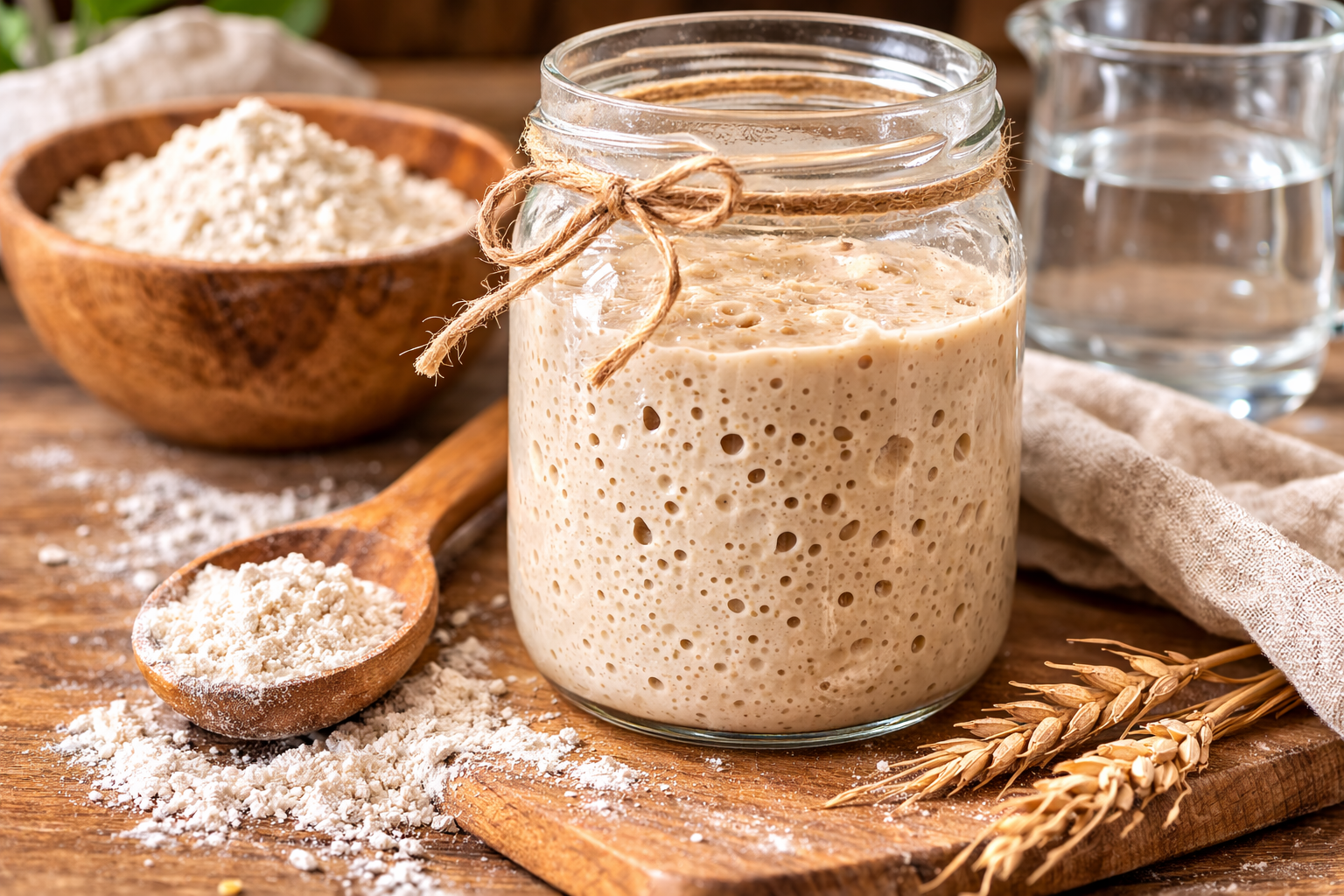
Photo of Simple Sourdough Starter Recipe from Scratch recipe
Home / Recipes / Simple Sourdough Starter Recipe from Scratch

Simple Sourdough Starter Recipe from Scratch

Build a lively, tangy sourdough starter with just flour, water, and patience. This clear, step-by-step guide helps you create a reliable wild-yeast culture for baking crusty loaves and tender sourdough breads.

Prep Time 15 min
🔥
Cook Time 30 min
Total Time 45 min
👥
Servings 4
Difficulty Easy
French Vegetarian

About This Recipe

Build a lively, tangy sourdough starter with just flour, water, and patience. This clear, step-by-step guide helps you create a reliable wild-yeast culture for baking crusty loaves and tender sourdough breads.

Ingredients

  • 100 g (3.5 oz) whole wheat flour
  • 100 g (3.5 oz) all-purpose flour
  • 200 g (7 oz) filtered or bottled water at room temperature (about 75°F/24°C), divided
  • 1 clean 1-quart (1 L) glass jar or container with loose-fitting lid or cloth cover
  • a digital scale or measuring cups/spoons
  • a non-reactive spoon or spatula for stirring
  • optional: 25 g (1.5 tbsp) rye flour for first feed to boost fermentation

Nutrition Facts

50 Calories 3% daily value
2.00g Protein 4% daily value
10.00g Carbs 3% daily value
0.00g Fat 0% daily value
1.00g Fiber 4% daily value

Instructions

  1. 1
    Step 1: Prepare workspace and equipment — clean a 1-quart glass jar and a spoon. Ensure water is chlorine-free (use filtered or let tap water sit uncovered for an hour).
  2. 2
    Step 2: Day 1 — Mix the initial starter: combine 100 g whole wheat flour and 100 g water in the jar. Stir thoroughly until no dry flour remains. Cover loosely with a cloth or lid to allow airflow and place in a warm spot (70–78°F / 21–26°C). Mark the level with a rubber band or tape.
  3. 3
    Step 3: Day 2 — Check for bubbles. You may see none or a few small bubbles and a faint aroma. Discard about half of the starter (roughly 100 g), then feed with 50 g all-purpose flour, 50 g whole wheat (or 100 g all-purpose), and 100 g water. Stir, cover, and return to the warm spot.
  4. 4
    Step 4: Day 3 — Expect more activity: bubbles, slight rise, and a tangy smell. Repeat the discard and feed routine: remove half, then add 100 g all-purpose flour and 100 g water. Stir and mark the level.
  5. 5
    Step 5: Days 4–6 — Continue twice-daily or daily feedings depending on activity and temperature. When starter doubles in volume within 6–8 hours of a feed and shows many bubbles, it's becoming mature. Maintain a consistent schedule: discard half and feed with equal weights of flour and water (for example, 50 g starter + 50 g flour + 50 g water).
  6. 6
    Step 6: Optional boost — If fermentation is sluggish, add 25 g rye flour during a feed (rye encourages wild yeasts) and keep the jar in a slightly warmer spot (around 75–78°F / 24–26°C).
  7. 7
    Step 7: Perform the float test — When your starter reliably doubles and is bubbly, test by dropping a teaspoon of starter in a glass of room-temperature water; a well-developed starter should float. If it sinks, continue regular feedings for a few more days.
  8. 8
    Step 8: Maintenance for baking — For regular baking, feed the starter and let it peak (double) before using. If baking daily, keep it at room temperature and feed once or twice daily. If baking less often, refrigerate after feeding and use within a week, feeding at least once weekly.
  9. 9
    Step 9: Preparing starter for use — For most recipes, discard down to an active quantity (or take the desired amount), then feed the remainder and let it peak. Use the portion taken in recipes as indicated.
  10. 10
    Step 10: Troubleshooting — If you notice pink, orange, or foul odors, or mold, discard the starter and begin again. A thin layer of liquid on top (hooch) is normal; pour off or stir it in and feed the starter.

💡 tips

Use a digital scale for consistent feeding by weight. Warmer temperatures speed fermentation; cooler temperatures slow it. Keep a discard jar for recipes (pancakes, crackers). If you need faster development, start with part rye or whole-grain flour for the first 2–3 days.

🔄 substitutions

For gluten-free options, use a gluten-free flour blend and expect different activity — consider adding fermented gluten-free flours like buckwheat or teff. If whole wheat is unavailable, use all-purpose flour; rye can be substituted with spelt to boost fermentation. Always avoid any alcoholic ingredients — no beer, wine, or spirits — and never use pork-derived additives.

📦 storage

Store starter in the refrigerator in a loosely covered jar if not used daily. Feed it at least once per week: remove, discard half, feed with equal weights of flour and water, let sit a few hours, then return to fridge. For long-term storage, dry a thin layer of starter on parchment and store flakes in an airtight container, or freeze a portion of well-fed starter in a sealed jar for several months.